Understanding Forklift Load Charts
Forklift load charts are one of the most important — and often misunderstood — safety tools on a forklift. Knowing how to read and apply a load chart is essential for safe operation, regulatory compliance, and preventing equipment damage or accidents.
At NovaLift Equipment, we frequently see issues caused by forklifts being operated outside their rated capacity simply because the load chart wasn’t fully understood. This guide breaks it down in a clear, practical way.
What Is a Forklift Load Chart?
A forklift load chart (also called a capacity plate or data plate) shows the maximum load a forklift can safely lift under specific conditions.
It accounts for factors such as:
- Load weight
- Load height
- Load center (distance from the forks)
- Mast type
- Attachments (side shifter, clamp, fork positioner, etc.)
If any of these factors change, the forklift’s true lifting capacity changes as well.
Why Forklift Load Charts Matter
- Ignoring or misunderstanding a load chart can lead to:
- Tip-overs
- Dropped loads
- Equipment damage
- Serious injury or fatal accidents
- OSHA / Ministry of Labour violations
Even a forklift that appears “strong enough” can become unstable if the load exceeds what the chart allows.
Understanding Load Capacity
Every forklift has a rated capacity, commonly shown as something like:
5,000 lbs @ 24-inch load center
This does not mean the forklift can safely lift 5,000 lbs in all situations.
It means the forklift can lift up to 5,000 lbs only when:
- The load center is 24 inches
- The mast and attachments match the configuration listed
The lift height does not exceed the specified maximum
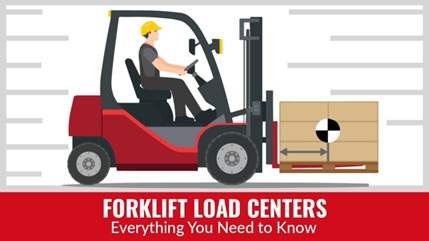
What Is Load Center?
The load center is the distance from the front face of the forks to the center of gravity of the load.
- Standard pallets are typically 24 inches deep
- Longer or uneven loads increase the load center
As the load center increases, lifting capacity decreases, even if the load weight stays the same.
How Lift Height Affects Capacity
To ensure safe operation:
- Follow all manufacturer load and slope ratings
- Ensure operators are properly trained and certified
- Perform daily pre-use inspections
- Use the lift only on approved surfaces
Proper training and maintenance are critical to maximizing safety and equipment lifespan.
Attachments Reduce Capacity
Forklift attachments significantly affect load capacity.
Common examples:
- Side shifters
- Paper roll clamps
- Carton clamps
- Fork positioners
Attachments:
- Add weight to the front of the forklift
- Move the load further away from the mast
Because of this, forklifts with attachments must have an updated load chart that reflects the new configuration.
Where to Find the Load Chart
The load chart is typically:
- Mounted on the forklift’s data plate
- Located near the operator’s seat
- Required by safety regulations
If the plate is missing, damaged, or unreadable, the forklift should not be operated until it is replaced.
Common Mistakes Operators Make
- Assuming the forklift can lift its “rated capacity” in all situations
- Ignoring load center changes
- Using attachments without updated capacity ratings
- Lifting loads higher than the chart allows
- Failing to verify load weight
These mistakes are a leading cause of forklift accidents.
Forklift Load Charts and Training
Forklift operator training programs include instruction on:
- Reading and interpreting load charts
- Understanding stability and center of gravity
- Recognizing unsafe loads
Operators should never guess — when in doubt, stop and verify.
How NovaLift Equipment Can Help
NovaLift Equipment provides:
- Forklift inspections
- Capacity plate replacements
- Attachment installations with updated load charts
- Operator training referrals
- Sales, rentals, and service support
If you’re unsure whether your forklift is being operated within its rated capacity, our team can help assess your equipment and ensure it meets safety requirements.
Understanding forklift load charts is critical for safe operation and compliance. Operating within rated limits protects operators, equipment, and your business.
Ready to Get Started?
Contact NovaLift Equipment today to learn more about forklift lifting capacity.
We also provide forklift training for crews in Toronto and across the GTA.
Contact us today to learn more about our material-handling products and services.