When shopping for a used forklift, operating hours are often one of the first things buyers look at. It makes sense—the hour meter provides a quick indication of how much the forklift has been used. However, forklift operating hours don’t tell the whole story.
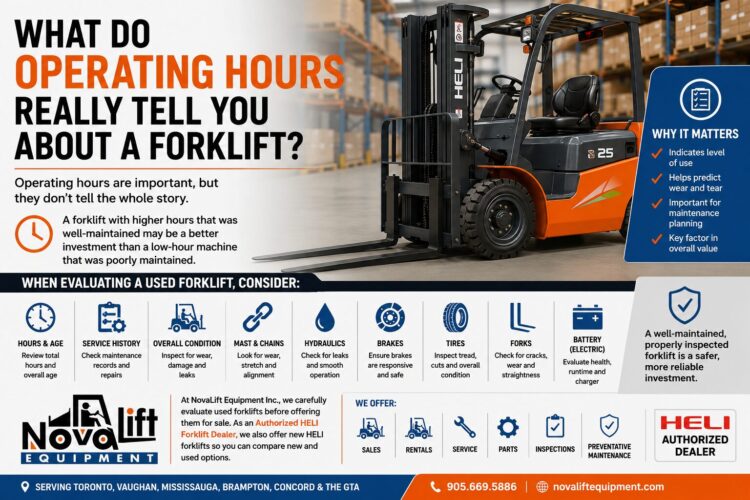
Just like mileage on a vehicle, hours are an important factor when evaluating used equipment, but they should never be considered on their own. A well-maintained forklift with higher hours can sometimes be a much better investment than a low-hour forklift that has been poorly maintained, improperly operated, or used in a harsh environment.
Understanding what forklift hours actually mean—and what else you should inspect—can help you make a more informed purchasing decision.
Are Lower Forklift Hours Always Better?
Generally speaking, lower operating hours are desirable because they usually indicate that the forklift has experienced less use. But two forklifts with exactly the same hours can have dramatically different conditions.
For example, a forklift with 8,000 hours that has received consistent preventative maintenance, regular inspections, proper lubrication, and repairs when required may still be in excellent operating condition.
Meanwhile, a forklift with only 4,000 hours could have experienced considerably more wear if it was poorly maintained, overloaded, operated aggressively, or used in a demanding environment.
That’s why NovaLift recommends looking at hours as one part of the overall condition assessment, rather than using them as the only deciding factor.
The Type of Hours Matters
Not all forklift operating hours are equal.
Consider the difference between a forklift operating occasionally inside a clean warehouse on smooth concrete and one working multiple shifts per day in a demanding manufacturing plant.
Forklifts operating in environments such as:
- Multi-shift manufacturing facilities
- Outdoor yards
- Construction-related applications
- Cold storage and freezer environments
- Dusty or dirty facilities
- Uneven operating surfaces
- Heavy production applications
may experience considerably different wear than equipment used occasionally in a clean warehouse.
The application and operating environment can therefore be just as important as the number displayed on the hour meter.
Service History Can Be More Important Than Hours
When evaluating a used forklift, one of the most valuable things to consider is how the equipment was maintained.
Regular forklift preventative maintenance helps identify developing problems before they turn into expensive repairs. Proper maintenance can also extend the useful life of major components.
When available, service records may provide information about previous maintenance and repairs, including work performed on the brakes, steering system, mast, chains, hydraulics, cooling system, electrical components, tires, and other areas of the forklift.
A higher-hour forklift with a strong maintenance history may therefore be preferable to a lower-hour machine with little or no evidence of regular maintenance.
What Else Should You Inspect on a Used Forklift?
Operating hours should always be considered alongside the forklift’s physical and mechanical condition.
Mast and Lift Chains
Inspect the mast for excessive wear, damage, leaks, and proper operation. Lift chains should be checked for wear, stretching, damaged links, and proper adjustment.
Because the mast and chains are responsible for raising and supporting the load, their condition is especially important.
Forks
Forks experience considerable stress throughout the life of a forklift. They should be inspected for wear, cracks, bending, damage, and other conditions that could affect their integrity.
Hydraulics
Hydraulic cylinders, hoses, fittings, and related components should be inspected for leaks and damage.
The mast should raise, lower, and tilt smoothly, and hydraulic attachments such as a side shift or fork positioner should operate correctly.
Brakes and Steering
A used forklift should steer properly and predictably, and its braking system should function correctly.
Unusual noises, excessive steering play, poor braking performance, or other abnormalities may indicate components requiring attention.
Forklift Tires
Tire condition can tell you quite a bit about how a forklift has been used.
Look for chunking, cracking, flat spots, uneven wear, cuts, and excessive wear. Worn tires not only represent an upcoming replacement expense but can also affect ride quality, stability, and operator comfort.
What About Hours on an Electric Forklift?
With a used electric forklift, the truck’s operating hours are only part of the equation.
The battery can represent a significant portion of the overall value of an electric forklift, so battery condition should be evaluated separately from the truck itself.
Factors to consider include the battery’s age, condition, charging history when available, maintenance, and expected runtime.
A low-hour electric forklift doesn’t automatically mean it has a good battery. Likewise, an older forklift with a properly maintained or recently replaced battery may represent better value than the hour meter initially suggests.
Age vs. Hours: Which Is More Important?
Both matter.
A relatively new forklift with extremely high hours may have experienced intensive multi-shift use. An older forklift with very low hours may have seen limited use but could still have age-related deterioration in hoses, seals, wiring, batteries, and other components.
This is why it’s important to consider forklift age, operating hours, maintenance history, application, and overall condition together.
No single number provides the complete picture.
What Is Considered High Hours on a Forklift?
There isn’t one universal number at which a forklift suddenly becomes “high hour” or should automatically be avoided.
Different forklift types, applications, maintenance histories, and operating environments can produce very different service lives.
A properly maintained forklift can continue providing dependable service at operating hours that might concern a buyer looking only at the meter.
Rather than asking only:
“How many hours does it have?”
A better question is:
“What condition is the forklift in considering its hours, age, maintenance history, and previous application?”
That provides a much better foundation for evaluating the equipment.
Don’t Buy a Used Forklift Based on Hours Alone
A low hour meter can certainly make a used forklift attractive, but it shouldn’t replace a proper equipment inspection.
Before purchasing a used forklift, consider the complete machine:
Operating hours + age + maintenance + previous application + mechanical condition + battery condition = a much better picture of the forklift’s true value.
This approach can help businesses avoid paying a premium simply because a forklift has low hours while overlooking more important mechanical issues.
Used Forklifts for Sale in Toronto & the GTA
At NovaLift Equipment Inc., we carefully evaluate used forklifts before offering them for sale. Our goal is to provide customers with the information they need to make an informed equipment decision rather than simply focusing on the number displayed on the hour meter.
Our inventory includes used electric forklifts, propane forklifts, reach trucks, pallet trucks, stackers, and other material handling equipment from major manufacturers.
And if purchasing used isn’t the best option for your operation, we can help you compare it against new equipment.
As an Authorized HELI Forklift Dealer, NovaLift offers a complete range of new HELI electric, lithium-ion, propane, diesel, warehouse, and material handling equipment. This allows customers to compare the cost and benefits of purchasing a used forklift against investing in a new HELI forklift with warranty and dealer support.
NovaLift also provides forklift rentals, parts, preventative maintenance, safety inspections, battery service, tire replacement, and mobile forklift repairs for all major makes and models.
Serving businesses throughout Toronto, Vaughan, Concord, Mississauga, Brampton, Markham, Richmond Hill, and the Greater Toronto Area, we’re here to help you find equipment that fits your application and budget.
Looking for a Used or New Forklift?
Don’t judge a forklift by its operating hours alone.
Contact NovaLift Equipment Inc. to discuss your requirements, explore our current used forklift inventory, or compare your options with a new HELI forklift.
Forklift Sales | Rentals | Service | Parts | Inspections | Preventative Maintenance | Toronto & the GTA
Get a Custom Quote Today
Ready to get moving? Contact us today or call 416-661-6262 for a fast, no-obligation quote.
Ready to Get Started?
Contact NovaLift Equipment today to learn more about all our forklift services.
We also provide forklift training for crews in Toronto and across the GTA.
Contact us today to learn more about our material-handling products and services.