Choosing the right forklift is an important decision for any warehouse, manufacturing facility, distribution centre, construction operation, or industrial business. The right equipment can improve productivity, reduce operating costs, increase efficiency, and minimize downtime. Choosing the wrong forklift can result in unnecessary costs, poor performance, and equipment that simply isn’t suited to the application.
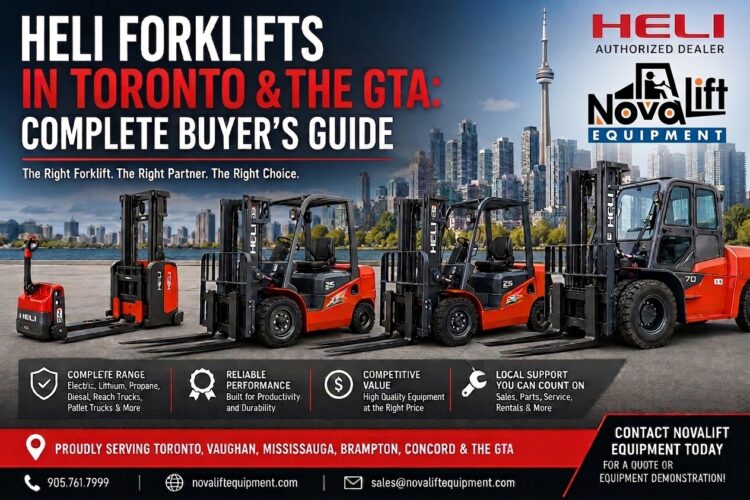
For businesses searching for HELI forklifts in Toronto and the Greater Toronto Area, HELI offers one of the most comprehensive material handling equipment lineups available, with solutions ranging from compact electric pallet trucks to high-capacity industrial forklifts.
As an Authorized HELI Forklift Dealer, NovaLift Equipment Inc. supplies new HELI forklifts and material handling equipment throughout Toronto, Vaughan, Concord, Mississauga, Brampton, Markham, Richmond Hill, and the GTA. We also provide local parts, warranty support, preventative maintenance, inspections, rentals, and mobile forklift service.
This guide covers some of the most important considerations when choosing a HELI forklift for your operation.
Who Is HELI?
HELI is a major global manufacturer of forklifts and material handling equipment, producing a broad range of equipment for warehouse, manufacturing, distribution, logistics, and heavy industrial applications.
One of HELI’s greatest advantages is the depth of its product lineup. Rather than concentrating on only one category of equipment, HELI manufactures everything from electric pallet trucks and warehouse equipment to counterbalance forklifts and high-capacity industrial trucks.
This allows businesses to consider equipment from the same manufacturer across multiple areas of their operation.
For companies looking for a combination of performance, reliability, modern technology, and competitive pricing, HELI has become an increasingly attractive alternative to many traditional forklift brands.
What Types of HELI Forklifts Are Available?
Not every application requires the same type of forklift. Before choosing a machine, it’s important to understand exactly how and where the equipment will be used.
The HELI product lineup includes a wide variety of material handling equipment, including:
- 3-wheel electric forklifts
- 4-wheel electric forklifts
- Lithium-ion forklifts
- Propane forklifts
- Diesel forklifts
- Cushion-tire forklifts
- Pneumatic-tire forklifts
- Reach trucks
- Double-reach trucks
- Order pickers
- Walkie pallet trucks
- Rider pallet trucks
- Walkie stackers
- Counterbalance walkie stackers
- Heavy-duty forklifts
- Rough-terrain forklifts
- Specialized warehouse equipment
The best machine depends on factors such as capacity, lift height, aisle width, operating environment, floor conditions, runtime requirements, attachments, and how many hours the forklift will operate each day.
HELI Electric Forklifts
Electric forklifts are an excellent choice for warehouses, manufacturing plants, food distribution facilities, and other primarily indoor applications.
Because they do not produce engine exhaust during normal operation, electric forklifts are particularly well suited to indoor environments.
Modern electric forklifts can also provide excellent acceleration, maneuverability, and operator comfort.
HELI offers both 3-wheel and 4-wheel electric counterbalance forklifts, allowing customers to choose a configuration that best suits their facility.
HELI 3-Wheel Electric Forklifts
A 3-wheel electric forklift is particularly useful in applications where maneuverability is important.
Their compact turning radius makes these forklifts ideal for:
- Narrow warehouse aisles
- Loading and unloading trailers
- Manufacturing facilities
- Distribution centres
- Indoor storage areas
- Operations where space is limited
If aisle width is a concern, a 3-wheel electric forklift can often provide greater maneuverability than a traditional 4-wheel counterbalance truck.
HELI 4-Wheel Electric Forklifts
A 4-wheel electric forklift provides the familiar layout and feel of a traditional counterbalance forklift while maintaining the benefits of electric power.
These machines are well suited to applications requiring frequent pallet handling, loading and unloading, and general warehouse or manufacturing work.
The correct choice between a 3-wheel and 4-wheel forklift will depend on the application, capacity requirements, floor conditions, aisle dimensions, and operator preferences.
HELI Lithium-Ion Forklifts
Lithium-ion technology has changed the electric forklift market considerably.
Traditional lead-acid batteries have served the material handling industry for decades, but lithium-ion batteries offer several operational advantages.
Depending on the application, benefits can include:
Opportunity Charging
Lithium batteries can often be charged during breaks, lunches, and other periods of inactivity, allowing businesses to add energy throughout the working day.
Reduced Battery Maintenance
Unlike traditional flooded lead-acid batteries, lithium-ion batteries don’t require routine battery watering.
Consistent Performance
Lithium batteries are designed to provide consistent power throughout their discharge cycle.
Simplified Charging
Depending on the equipment configuration, lithium charging can be very convenient for operators and facilities.
For operations running extended shifts or businesses that want to reduce battery maintenance, a HELI lithium-ion forklift may be worth considering.
However, lithium isn’t automatically the best choice for every customer. Operating hours, charging availability, equipment utilization, initial investment, and application should all be considered before deciding between lithium-ion and traditional lead-acid battery technology.
HELI Propane Forklifts
Propane forklifts remain extremely popular throughout the GTA.
A propane counterbalance forklift can be an excellent option for businesses that require a versatile machine capable of working in a variety of applications.
Propane forklifts are commonly found in:
- Warehouses
- Manufacturing plants
- Shipping departments
- Distribution centres
- Building supply operations
- Industrial facilities
One advantage is the ability to quickly replace an empty propane cylinder and return the forklift to operation rather than waiting for a battery charging cycle.
When selecting a propane forklift, customers should consider capacity, mast height, tire type, indoor/outdoor operation, attachments, and emissions requirements.
HELI Diesel Forklifts
For demanding outdoor and heavy industrial applications, diesel forklifts remain a practical solution.
Diesel forklifts are commonly used in lumber yards, construction environments, manufacturing operations, transportation facilities, steel applications, and other demanding workplaces.
HELI offers diesel-powered equipment across multiple capacity ranges, including equipment designed for substantially heavier loads than a conventional warehouse forklift.
For businesses moving heavy materials outdoors, a HELI diesel forklift may provide the power and durability required for the application.
HELI Cushion vs. Pneumatic Tire Forklifts
Choosing the proper tire configuration is another important consideration.
Cushion Tire Forklifts
Cushion-tire forklifts are typically designed for smooth indoor surfaces.
Their compact design can offer a smaller turning radius, making them particularly useful in warehouses and manufacturing facilities where space is limited.
Pneumatic Tire Forklifts
Pneumatic-style forklifts generally provide additional ground clearance and are better suited to applications where the forklift may encounter rougher surfaces or travel outdoors.
Solid pneumatic tires can also provide durability without the puncture concerns associated with air-filled tires.
If your forklift will regularly travel between a warehouse and an outdoor yard, it’s important to consider floor and ground conditions before selecting the tire configuration.
HELI Reach Trucks for Narrow-Aisle Warehouses
Counterbalance forklifts aren’t always the best choice for warehouse racking.
Facilities with narrow aisles and high storage racks may benefit from a HELI reach truck.
Reach trucks are specifically designed for warehouse environments where maximizing storage density is important. Their compact design allows them to operate in narrower aisles while reaching loads stored at greater heights.
Before selecting a reach truck, it’s important to determine:
- Maximum required lift height
- Maximum load weight
- Load dimensions
- Aisle width
- Rack configuration
- Required lowered mast height
- Battery/runtime requirements
- Single-reach or double-reach requirements
These measurements should be reviewed carefully before ordering equipment.
HELI Pallet Trucks and Stackers
Not every material handling task requires a counterbalance forklift.
For moving palletized products at ground level, an electric pallet truck may provide a much more economical solution.
HELI offers several types of Class III warehouse equipment designed for different applications.
Electric pallet trucks are useful for moving pallets across warehouses, loading areas, production facilities, and distribution centres.
Stackers provide additional lifting capability for applications where pallets need to be raised or placed into lower-level racking.
Selecting the right equipment for each task can help reduce unnecessary forklift usage and improve overall fleet efficiency.
HELI High-Capacity Forklifts
Some industrial operations require considerably more capacity than the typical 5,000 lb warehouse forklift.
HELI offers high-capacity forklifts for demanding material handling applications.
These types of forklifts may be used for handling:
- Steel
- Machinery
- Building materials
- Manufacturing equipment
- Large industrial components
- Heavy loads
- Specialized materials
High-capacity applications require particularly careful equipment selection.
Load weight alone is not enough to properly specify a forklift. Load dimensions, load centre, attachment weight, lift height, and operating conditions can all affect the forklift’s actual capacity.
Understanding Forklift Capacity and Load Centre
One of the most important factors when buying any forklift is understanding that the rated capacity isn’t necessarily the amount the forklift can lift in every situation.
Forklift capacity is based on specific conditions, including a specified load centre.
Longer loads move the centre of gravity farther away from the forklift, potentially reducing available capacity.
Attachments can also affect capacity.
For example, equipment such as:
- Fork positioners
- Clamps
- Rotators
- Extended forks
- Specialized attachments
can change the effective capacity of the forklift.
This is why NovaLift recommends reviewing the actual load weight, load dimensions, required lift height, and attachment requirements before selecting a forklift.
How High Does Your Forklift Need to Lift?
Customers frequently focus on forklift capacity but overlook mast specifications.
The required lift height should be determined by measuring the highest location where the forklift will need to place a load.
But maximum fork height isn’t the only measurement that matters.
You should also consider the forklift’s:
Lowered Mast Height – Will the forklift fit through your doors, dock doors, trailers, or other height restrictions?
Free Lift – How high can the forks rise before the mast begins extending?
Overall Raised Height – Is there adequate overhead clearance?
A 3-stage mast is popular because it can provide a good combination of lift height, free lift, and relatively low collapsed mast height.
How Much Capacity Do You Really Need?
A forklift should never be selected based only on the weight of the heaviest load.
For example, if your maximum pallet weighs approximately 4,500 lbs, simply assuming that a 5,000 lb forklift is automatically appropriate may not account for unusual load dimensions, attachments, or required lift height.
When specifying a forklift, NovaLift looks at the complete application.
Providing your dealer with accurate information before ordering equipment helps ensure the forklift is properly configured for the job.
Consider Your Aisle Width
Aisle width can significantly influence which type of forklift is suitable.
A traditional counterbalance forklift requires more room to turn and position a load than a reach truck.
Before purchasing equipment for an existing warehouse, measure:
- Clear aisle width
- Rack-to-rack distance
- Pallet dimensions
- Load dimensions
- Turning areas
- Door openings
- Overhead restrictions
A few measurements taken before purchasing can prevent an expensive equipment mismatch.
Lead-Acid vs. Lithium-Ion Batteries
For electric forklift buyers, battery selection is another major decision.
Lead-Acid
Traditional lead-acid forklift batteries remain widely used and can provide excellent service when properly maintained.
They generally require:
- Regular charging
- Proper watering
- Periodic cleaning
- Appropriate charging infrastructure
- Proper battery maintenance
Lithium-Ion
Lithium batteries require considerably less routine maintenance and can provide greater charging flexibility.
The best choice depends on how your operation uses the forklift.
A single-shift facility operating a forklift only a few hours per day may have very different battery requirements than a busy distribution centre operating multiple shifts.
New HELI Forklift vs. Used Forklift
Buying new isn’t necessarily the right solution for every customer.
A quality used forklift can offer excellent value for businesses with lower utilization or limited budgets.
However, new equipment offers several advantages, including:
- New equipment warranty
- Known equipment history
- Latest technology
- Configuration to your application
- New battery or power system
- Predictable maintenance
- Longer expected service life
Because NovaLift supplies both new HELI forklifts and quality used forklifts, we can help customers compare both options rather than automatically recommending one over the other.
Don’t Compare Forklifts on Purchase Price Alone
The lowest purchase price isn’t necessarily the lowest-cost forklift to own.
When comparing equipment, consider the total cost of ownership.
This can include:
- Purchase price
- Financing cost
- Energy or fuel consumption
- Preventative maintenance
- Replacement parts
- Battery costs
- Tire replacement
- Downtime
- Warranty coverage
- Service availability
- Expected useful life
- Resale value
A forklift that costs slightly more initially but provides dependable service and readily available support may ultimately be less expensive to operate.
Parts and Service Support Matter
The relationship with your forklift dealer shouldn’t end when the machine is delivered.
Even reliable equipment requires routine maintenance, inspections, tires, parts, and occasional repairs.
This is one of the reasons we believe customers should consider local dealer support when comparing forklift brands.
As an Authorized HELI Forklift Dealer, NovaLift provides customers with local support throughout the GTA, including:
- HELI forklift sales
- Forklift rentals
- Parts
- Warranty support
- Preventative maintenance
- Mobile forklift repairs
- Safety inspections
- Battery service
- Forklift tires
- Equipment consultation
Our technicians also service all major forklift makes and models, allowing businesses with mixed fleets to work with one service provider.
Why Buy From an Authorized HELI Forklift Dealer?
Buying from an authorized dealer provides more than access to the equipment itself.
A local authorized dealer can help determine the correct specifications before the equipment is ordered and provide support after delivery.
At NovaLift Equipment Inc., our goal is to understand the customer’s application first.
We can review your capacity requirements, load dimensions, lift height, aisle width, operating environment, hours of use, power preference, attachments, and budget before recommending equipment.
That can help prevent buying too much forklift—or worse, purchasing a forklift that doesn’t meet the application.
HELI Forklift Rentals in the GTA
Purchasing isn’t always the best solution.
Forklift rentals can make sense for:
- Seasonal demand
- Temporary projects
- Equipment breakdowns
- Increased production
- Short-term contracts
- Warehouse moves
- Special projects
- Businesses wanting to preserve capital
NovaLift provides forklift rental solutions throughout Toronto and the GTA, with equipment available for a variety of material handling applications.
For businesses considering a purchase, renting can also provide an opportunity to evaluate the type of equipment that works best for their operation.
What Information Should You Have Before Requesting a Forklift Quote?
The more information you provide, the easier it is to recommend the correct forklift.
Before requesting a quote, try to determine:
Maximum load weight: What is the heaviest load you will lift?
Load dimensions: How long and wide is the load?
Maximum lift height: What is the highest rack position?
Aisle width: How much operating space is available?
Indoor or outdoor: Where will the forklift operate?
Floor conditions: Smooth concrete, asphalt, gravel, uneven surfaces?
Operating hours: How many hours per day will the forklift be used?
Power preference: Electric, lithium-ion, propane, or diesel?
Attachments: Do you require side shift, fork positioner, clamps, extended forks, or another attachment?
Door height: What is the lowest overhead clearance the forklift must pass through?
Providing this information helps NovaLift recommend equipment based on your actual application, rather than simply quoting a generic forklift.
Why GTA Businesses Are Considering HELI Forklifts
For many businesses, the attraction of HELI comes down to a straightforward combination: a broad product range, competitive pricing, modern electric and lithium technology, conventional IC forklifts, warehouse equipment, and local dealer support.
A company may need a pallet truck today, a 5,000 lb electric counterbalance forklift next year, and a high-capacity forklift as its operation grows. Having access to a broad equipment lineup can simplify fleet planning.
More importantly, businesses need to know that someone will be there to support the equipment.
That’s where NovaLift comes in.
Your Authorized HELI Forklift Dealer in Toronto & the GTA
NovaLift Equipment Inc. is an Authorized HELI Forklift Dealer serving businesses throughout Toronto, Vaughan, Concord, Mississauga, Brampton, Markham, Richmond Hill, and the Greater Toronto Area.
Whether you’re looking for a HELI electric forklift, lithium-ion forklift, propane forklift, diesel forklift, reach truck, pallet truck, stacker, narrow-aisle forklift, rough-terrain forklift, or high-capacity forklift, our team can help determine which equipment best matches your application.
In addition to new HELI equipment, NovaLift offers a large selection of quality used forklifts, forklift rentals, parts, preventative maintenance, safety inspections, battery service, tire replacement, and mobile forklift repairs.
Our objective isn’t simply to sell you a forklift. It’s to help you select equipment that makes sense for your operation and provide the local service and support needed to keep it working.
Looking for a HELI Forklift in Toronto or the GTA?
If you’re considering a new forklift, talk to NovaLift before making your decision.
We can review your application, compare equipment options, determine the appropriate capacity and specifications, and help you decide whether electric, lithium-ion, propane, or diesel is the best choice for your operation.
Contact NovaLift Equipment Inc. today for a HELI forklift quote, equipment consultation, demonstration, rental, parts, or service.
Authorized HELI Forklift Dealer | Sales | Rentals | Parts | Service | Toronto & the GTA
Get a Custom Quote Today
Ready to get moving? Contact us today or call 416-661-6262 for a fast, no-obligation quote.
Ready to Get Started?
Contact NovaLift Equipment today to learn more about all our forklift services.
We also provide forklift training for crews in Toronto and across the GTA.
Contact us today to learn more about our material-handling products and services.